
The media industry is undergoing a profound transformation. Production environments are becoming increasingly software-defined, distributed, and interconnected. While standards such as NMOS have significantly improved interoperability for discovery and control, the industry still faces an important challenge: how to efficiently share live media between applications without relying on proprietary integrations, unnecessary copies, or file-based exchanges.
This is where DMF-MXL (Dynamic Media Facility – Media eXchange Layer) comes into play.
What is DMF-MXL?
DMF is an industry initiative promoted by the EBU (European Broadcasting Union) to explore next-generation architectures for software-defined media infrastructures. As part of this initiative, MXL (Media eXchange Layer) introduces a new approach for sharing media between applications operating within the same production environment.
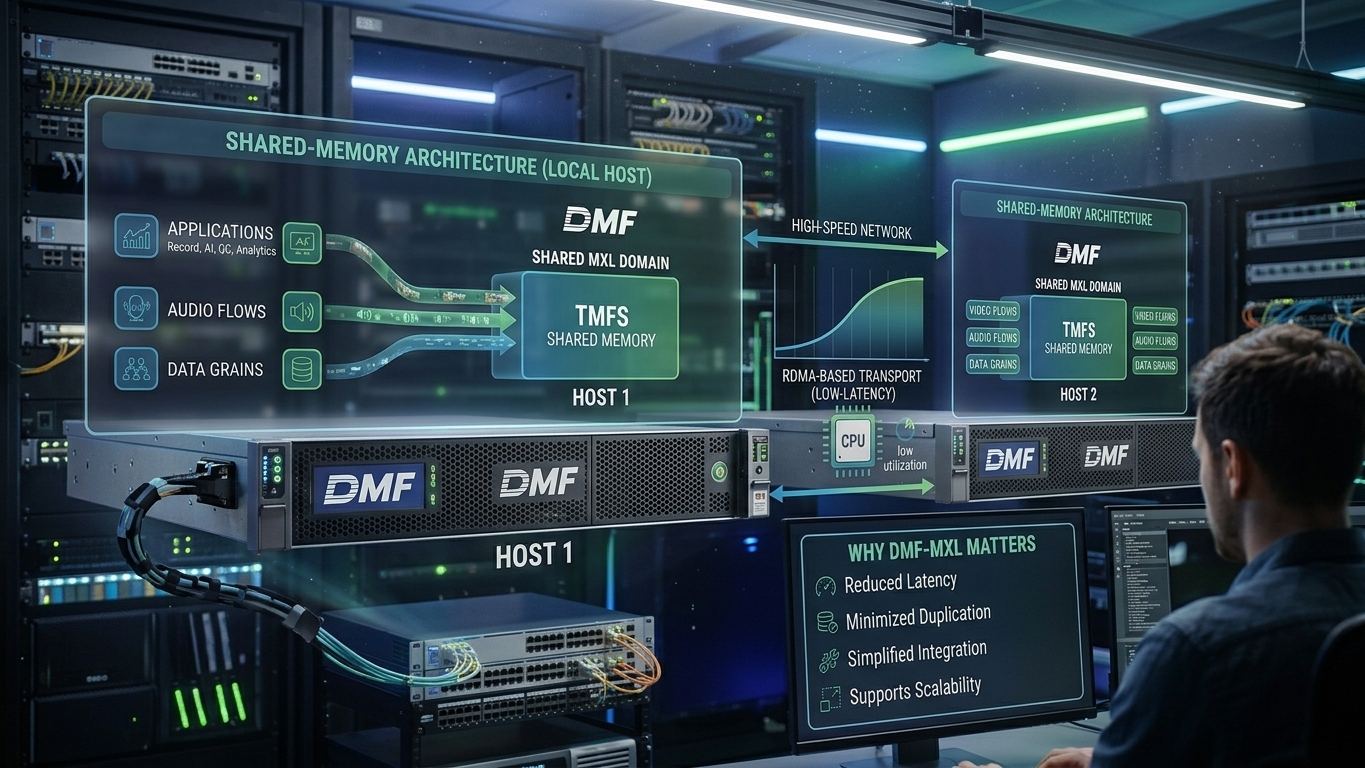
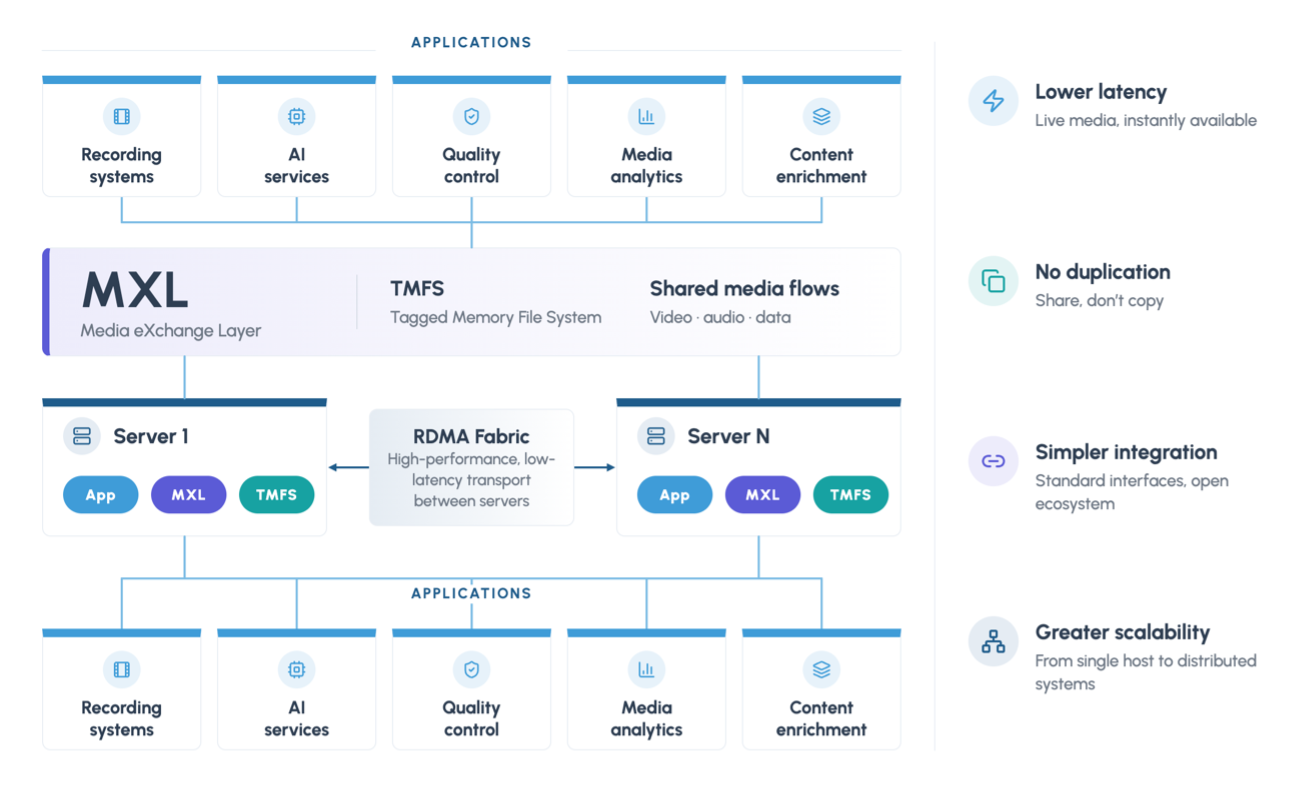
Unlike traditional media workflows based on file transfers and transport streams, MXL is built around a shared-memory architecture. At its core is TMFS (Tagged Memory File System), a memory-resident file system where video, audio, and data are exposed as reusable media flows. Rather than repeatedly moving media between applications, content is published into shared MXL domains where multiple systems can simultaneously access the same live flows without creating additional copies. By treating media as a shared resource instead of something that must be continuously transferred, MXL reduces latency, minimizes duplication, simplifies integration, and provides a more efficient foundation for modern software-defined media workflows.
High-Performance Media Sharing
The shared-memory architecture provided by MXL becomes even more powerful when media must be exchanged across multiple servers. While TMFS enables applications running on the same host to share media through a common memory space, distributed production environments require the same efficiency beyond a single machine.
To address this challenge, the DMF-MXL ecosystem includes Fabrics components that leverage RDMA (Remote Direct Memory Access), a technology widely adopted in high-performance computing and supercomputing environments. RDMA enables data to be transferred directly between the memory spaces of different servers with minimal CPU involvement and extremely low latency, often measured in just a few microseconds.
By combining shared-memory domains with RDMA-based transport, MXL makes it possible to replicate live media flows between hosts while preserving many of the performance characteristics of local memory access. This approach reduces the overhead traditionally associated with stream-based transport and creates a highly efficient foundation for distributed media workflows, where multiple applications can collaborate on the same content regardless of where they are deployed.
Why This Matters
As media infrastructures become increasingly software-defined, production workflows rely on a growing number of specialized applications, including recording systems, AI services, quality control tools, media analytics platforms, and content enrichment solutions.
DMF-MXL provides a common foundation that allows these applications to exchange media efficiently while remaining loosely coupled. This flexibility simplifies integration, improves scalability, and supports future innovations in automation, AI-assisted production, and next-generation media workflows.
Integrating DMF-MXL into Tedial Stream
The DMF-MXL initiative provides an official open-source SDK available on GitHub, including the core MXL libraries, development tools, diagnostic utilities, Fabrics components, and GStreamer source and sink plugins.
Our approach focused on integrating the official DMF-MXL ecosystem into a real media recording platform. The GStreamer plugins included in the SDK provide a straightforward mechanism for publishing and consuming MXL flows from standard media applications. This allowed us to leverage existing GStreamer pipelines without requiring direct integration with the native MXL API.
Within Tedial Stream, the DMF-MXL components are used in three different areas:
a) Flow Discovery
Tedial Stream periodically scans configured MXL domains and automatically discovers available video and audio flows. By analysing the metadata associated with each flow, the system can identify related audio and video sources and automatically create logical recording channels. This allows newly published MXL sources to become immediately available for scheduling and recording without requiring manual configuration.
b) MXL-based Recording
For recording purposes, Tedial Stream uses the official DMF-MXL GStreamer plugins to consume MXL flows directly from the discovered domains. Once a recording is scheduled, the platform dynamically builds a GStreamer pipeline that reads the MXL flows and records them using the standard Tedial Stream recording infrastructure. From an operational perspective, MXL sources can therefore be managed in the same way as any other recording source supported by the platform.
c) Distributed Acquisition with Fabrics
One of the challenges when working with MXL is that media domains are typically local to a particular host. To address this limitation, we also evaluated the Fabrics components included in the DMF-MXL project, which allow media flows generated on one server to be replicated into an MXL domain located on a different host.
In our implementation, live MXL content is transported from the production environment to Tedial Stream recording servers, where the replicated flows are discovered and recorded. This enables a clear separation between media production environments and recording infrastructure while maintaining the benefits of the MXL architecture.
Bringing DMF-MXL into Production Workflows
The result of this integration is a seamless, end-to-end workflow. It begins when a media producer generates live content and exposes it to the local MXL domain. From there, Fabrics replicates these live flows across hosts, allowing Tedial Stream to automatically detect the available streams and create logical recording channels. Once configured, scheduled recordings capture the media seamlessly.
By combining the official DMF-MXL SDK, GStreamer plugins, and Fabrics, Tedial Stream demonstrates how DMF-MXL can be integrated into real-world media workflows, providing a practical bridge between emerging DMF technologies and operational broadcast environments.
Current Challenges and Opportunities
As with many emerging technologies, MXL is still evolving. Key areas that still present operational challenges include the dynamic discovery and association of related video and audio flows, efficient domain replication across different hosts, the distributed orchestration of media flows across networks, and the management of large-scale, multi-node deployments.
At the same time, these challenges represent significant opportunities for innovation. As broadcast infrastructures continue to evolve toward cloud-native services and AI-driven automation, the need for efficient media interchange mechanisms will only increase.
Looking Ahead
The industry has spent decades optimizing how media is moved between systems. DMF-MXL shifts the conversation toward a different question: What if media could simply be shared?
By introducing a common shared layer for live media, DMF-MXL opens the door to a new generation of interoperable workflows where applications focus on processing, enriching, understanding, and using media rather than transporting it.
For broadcasters and media organizations looking to build more open, scalable, and intelligent production environments, DMF-MXL represents an important step toward the future of software-defined media infrastructures. As adoption grows, technologies such as MXL have the potential to become a foundational layer in next-generation media ecosystems.
Tedial Stream currently includes support for MXL discovery and recording, enabling organizations to evaluate and integrate DMF-MXL workflows within real production environments.
If you’re interested in software defined live content recording and production, we can help. For more information, contact marketing@tedial.com