
Modernizing and migrating systems and services are necessary to accelerate digital transformation and represent a significant shift for many companies in the M&E market. This change is both technological and cultural. Migrating from monolithic legacy Media Asset Management (MAM) systems cannot happen overnight.
To effectively migrate legacy systems across various IT verticals, new models based on microservices and integration platforms as a service (iPaaS) are being widely adopted, maximizing architectural modularity. Tedial’s smartWork platform, iPaaS for media content, adds AI and compositing capabilities to software and helps customers quickly transition to a composable, agile, and resilient architecture, accelerating the migration of legacy MAMs to cloud, on-premise or hybrid deployment, ensuring business continuity.
A Strategic View: More than a Migration
A MAM migration should never be approached as a simple “lift and shift” exercise. Before starting the process, organizations must take a broader strategic view and define what the next-generation MAM ecosystem should become.
This means rethinking workflows, metadata models, accessibility, interoperability, and the way content will be consumed and distributed in the future. It also requires preparing the platform for new media formats, AI-driven operations, cloud-native scalability, hybrid deployment and increasingly demanding content delivery requirements.
The goal is not to replicate the limitations of a legacy repository in a new system, but to evolve toward a fully connected, intelligent, and flexible media supply chain. An AI-powered MAM such as Tedial EVO enables organizations to transform fragmented archives into accessible, searchable, and operationally efficient content ecosystems, ready for modern multi-platform consumption and future business demands.
Challenges of a Legacy System Migration
Legacy migration is the process of transitioning outdated software to modern technologies, which helps businesses to unlock new opportunities and stay competitive. Some of the most relevant challenges that affect the migration process of a legacy system are the following:
Data complexity and integrity.Legacy systems often have intricate data structures and inconsistent data quality. Therefore, it’s difficult to migrate data accurately and maintain integrity during the migration process. The sheer volume of data and the lack of standardization can pose significant hurdles.
Compatibility and integration. Legacy systems may have compatibility issues with modern technologies and require seamless integration with other systems and applications. The lack of general standardized protocols and interfaces can hinder the integration process.
Knowledge gaps and expertise. Legacy systems often rely on outdated technologies and may require rare skills and knowledge to migrate and maintain efficiently. The lack of such specific expertise could result in delays and errors during the migration process.
Change management and user adoption. Legacy system migration involves a significant change for all users. They may encounter difficulties in adopting the new system. Successful utilization of the migrated system can happen only with effective change management.
Testing and compliance. Legacy system migration needs comprehensive testing to validate the functionality, performance, integration, and compliance of the new system. Without adequate testing, you can face operational issues and non-compliance with regulatory requirements.
Disruption of business operations. Legacy system migration might disrupt daily business operations, leading to downtime and loss of productivity. The unavailability of systems that are crucial for business can affect customer service and revenue generation.
Legacy MAMs at a Crossroads
Many media organizations are still operating on legacy or in-house MAM systems that are neither future-proof nor agile enough to meet today’s demands. These outdated architectures create friction, limit scalability, and slow innovation.
In many cases, organizations use MAM systems that are nearing the end of their useful life. To compensate for the shortcomings of these systems, some have developed in-house tools over the years, which now need to be replaced with standard, interoperable technologies. Migration is inevitable, but it must be smooth and seamless:
- Operational continuity is paramount: all stakeholders emphasized the need to maintain operations during the migration. Downtime is unacceptable.
- Standardization over customization: the current trends are towards modular, open solutions that reduce technical debt and simplify future upgrades.
Tedial’s approach to seamless migration, thanks to its smartWork abstraction layer, is a key aspect that has generated significant interest. The platform’s philosophy, based on no-code programming, aligns perfectly with these trends.
Media companies are moving toward modular, cloud-native hybrid architectures that support integration and scalability. This isn’t just about technology, it’s about future-proofing operations and unlocking agility for rapid change.
Migrating a Legacy MAM
The duration of a media migration depends largely on the number of hours of content, the age of the LTO tapes, and the processing involved in the migration workflow.
Furthermore, the migration will depend on the number of files, the technical parameters of the high-resolution media (size, codec, bitrate, duration) and the LTO tape (read speed), as well as the level of system concurrency (LTO tape drivers, transcoders, quality control, etc.).
There are different methods and scenarios for implementing the migration of a legacy MAM to a new AI-powered MAM. What M&E organizations demand is that the migration be completed in the shortest possible time, that business continuity be guaranteed, and that the customer have the freedom to create new services without depending on the vendor of the new MAM.
The simplest method consists of performing the migration on demand. The legacy MAM publishes the media HR and a XML file with the asset metadata to a folder. A trigger launches a standard ingest workflow in the target MAM. Clearly, this process is slow and impractical when the number of assets is large. Therefore, we are interested in advanced methods that accelerate and automate the migration process.
In fact, metadata migration can be performed very efficiently by exporting the database from the legacy MAM to an export XML file, which we place in a folder, to then proceed with the correct mapping of the metadata between the legacy MAM and the new MAM.
Media migration presents a more complex set of scenarios due to the diversity of possible situations. In all cases, reducing migration time should be a priority, while ensuring business continuity. To achieve this, we will need new, very fast and efficient microservices for processing and generating orders in scenarios with millions of assets.
Order Scheduler: This microservice processes metadata (XML file) and generates batch ingestion orders for migration, or delivery orders for linear (playout) and non-linear (OTT platforms) distribution, as well as delivery for localization, social media, and other processes. The microservice must be designed to handle very high migration order loads. We are talking about batch processing millions of asset migration orders.
As we know, legacy MAM relies on a HSM or datamover to manage the multi-tier hierarchical storage system. The most frequent case is the migration of HR media stored on LTO tapes. We know that the efficiency of downloading files from a LTO tape is highly dependent on the LTO tape read order and the number of times the LTO tape is read. To accelerate media migration, smartWork includes a specific microservice.
Media Migration: This microservice integrates with the storage manager to import the LTO tape inventory and the list of files contained on each tape. Media migration manages the ever-increasing reads of entire LTO tapes. While an LTO tape is being downloaded, the microservice creates the corresponding media ingestion orders in the new MAM, scheduling the various high-resolution media ingestion workflows in batches.
To maintain business continuity and accelerate the migration of legacy MAMs, some customers prefer not to migrate their hierarchical storage management system and instead keep the average HR on the LTO tapes. In this case, it is necessary to integrate the existing storage manager with the new MAM. The most relevant example is the Diva datamover, which is used by many legacy MAMs.
The process of integrating the datamover with the new MAM is quick and simple: Export the Diva database, including the HR media inventory contained in each LTO tape. Generate a unique identifier (sobject) for each HR file and register the information in the new MAM (diva_name, diva_category, diva_tapes). The entire process is performed without needing to reread the LTO tapes. The new MAM will be able to make requests to the datamover using the registered triplet.
One of the biggest challenges in media migration is ensuring proxy compatibility with the new MAM system, as regeneration can be slow and customers want to use the new system as soon as possible. Furthermore, the customer’s site may have other applications that need to use the legacy proxy until they are migrated in a subsequent project.
Playlist Streaming: Tedial has developed a “Multi-Format Proxy Streaming” (MFPS) microservice that guarantees instant playback of legacy proxies (Windows Media, MPEG, MP4, MOV, etc.) on the new MAM player. The MFPS microservice transcodes and/or repackages the proxy in real time, generating a DASH stream. This eliminates the bottleneck of pre-regenerating the proxy, a task that can be performed once the new MAM is in production.
Business Intelligence. This microservice facilitates the monitoring of the migration process through a set of customizable dashboards that display real-time information and can help identify bottlenecks, providing valuable insights to ensure that migration performance is optimized throughout the process.
Business Continuity: The Critical Requirement
As mentioned earlier, business continuity is non-negotiable when migrating a live legacy MAM environment. A migration project cannot disrupt daily operations, content accessibility, or user productivity. To guarantee a seamless transition, three critical pillars must be addressed:
- Metadata Accessibility. All content and metadata must remain accessible from day one of the migration process. This requires a staged and incremental metadata migration strategy, where bulk metadata is migrated in advance and continuously synchronized until the final cutover. By minimizing the delta between systems, organizations significantly reduce operational risk and ensure uninterrupted access to business-critical assets.
- High-Resolution Media Accessibility. Access to high-resolution media must also be preserved throughout the migration. Tedial AST abstracts the physical location of media assets, enabling transparent restore operations regardless of where the content resides — whether on legacy LTO archives, existing storage infrastructures, or the new platform. This abstraction layer guarantees operational continuity while long-term migrations and archive consolidations are still in progress.
- Playlist and Proxy Streaming Continuity. Tedial has developed the MFPS microservice to ensure immediate playback compatibility for legacy proxy formats such as Windows Media, MPEG, MP4, MOV, and others within the new MAM environment. MFPS dynamically transcodes or repackages multi-format proxies in real time, generating adaptive DASH streams for instant playback. This removes the need for massive proxy pre-regeneration processes prior to go-live, eliminating one of the most common migration bottlenecks and accelerating time-to-production.
By combining these three pillars, the migration process becomes effectively transparent to end users, ensuring uninterrupted operations while enabling a controlled and future-ready transition to the new AI-powered MAM ecosystem.
Realtime Migration Insights
Next-generation AI-powered MAM systems transform content into a dynamic, monetizable asset. A sound migration strategy from legacy systems is critical to accelerating time to market, enabling smarter distribution strategies and a higher return on investment for content.
Words like speed, scale, and quality are routinely used in the media industry, but it’s important to measure how fast migration processes actually are and their direct impact on the bottom line. The smartWork platform’s migration strategy and its advanced microservices dramatically accelerate legacy MAM migration to cloud, on-premise or hybrid deployment, ensuring business continuity.
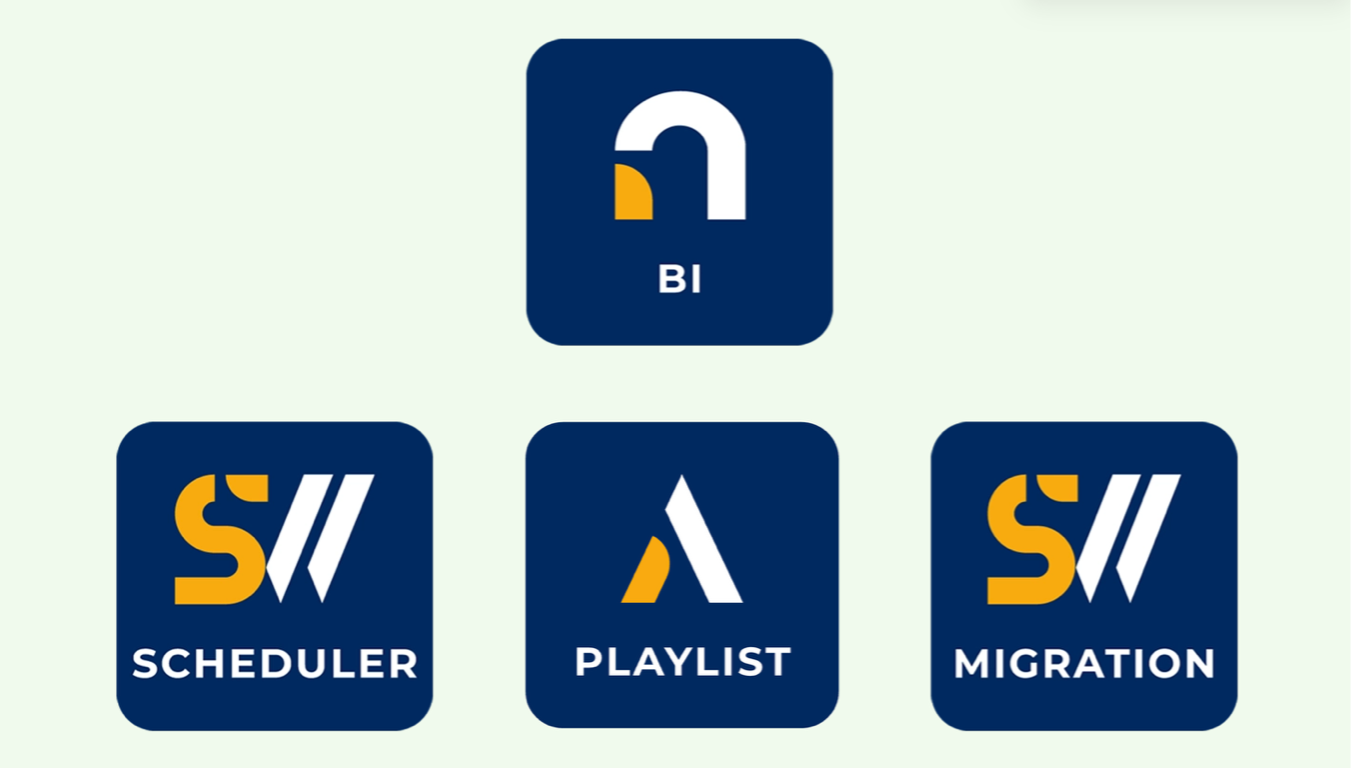
The availability of Order Scheduler, Media Migration, Playlist Streaming and Business Intelligence microservices on the smartWork integration platform, allows for complete control over the legacy MAM migration process, including temporary shutdowns and operational resumptions.
The urgency to replace rigid, monolithic platforms has never been greater. Tedial has started the year with a number of digital transformation projects in the M&E market. All of them include the migration of legacy MAM systems: Reach Engine, Navigator X, Invenio, Galaxy Five and in-house systems.
Tedial remains committed to modernizing the industry through innovative tools and ongoing support for a resilient media ecosystem.
If you’re interested in replacing a legacy MAM, we can help. For more information, contact marketing@tedial.com
About Tedial
Tedial is a global innovation-focused tech company leading next-generation AI-powered media asset management (EVO MAM) with the first no-code media integration platform (smartWork), designed to accelerate digital transformation, upgrade your business, scale your media supply chain, and focus on intelligent, resilient, cloud-smart hybrid media solutions.